

04 Jun 2026
For Help and Advice call: 01524 888453
Our blog28 Apr 2026
For many people, the challenge is not just getting around. It is managing the practical side of mobility. Where do you store a scooter in a smaller home? How do you take it in a taxi, on a bus, or on holiday? And how do you do all of that without turning every trip into a logistical task?
Folding mobility scooters have become increasingly popular because they address these exact problems. Instead of dismantling parts or relying on others to help, they are designed to simplify movement from the moment you leave your home to the moment you arrive at your destination.
If your goal is to stay mobile without adding complexity to travel or storage, understanding how folding scooters work and where they fit is essential.
Folding scooters are built around one core advantage: simplicity. Rather than breaking the scooter down into separate pieces, the entire unit folds into a compact shape that can be stored or transported quickly.
This shift in design changes how people use mobility equipment day to day. Instead of planning ahead for assembly and lifting, the process becomes far more immediate and manageable.
They appeal to users because they:
The result is a more flexible approach to mobility. You are not adapting your plans around the scooter. The scooter adapts to your routine.
The real impact of a folding scooter becomes clear when you look at how it fits into everyday situations.
At home, storage is often a concern. Larger scooters can take up significant space or require dedicated areas to keep them accessible. Folding scooters reduce that pressure. They can be stored in smaller rooms, tucked away when not in use, and accessed without rearranging your environment.
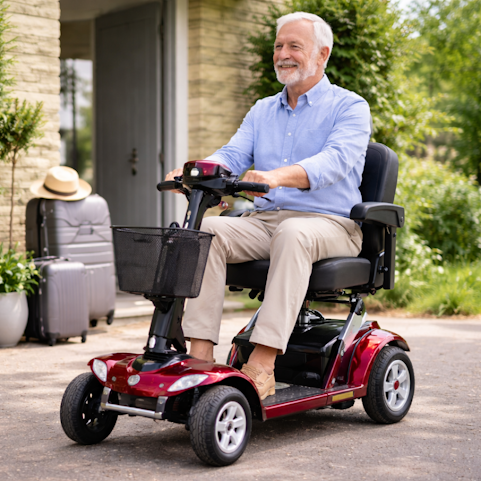
When travelling, the difference becomes even more noticeable. Getting into a taxi or a family car no longer involves dismantling multiple parts or managing heavy components. Instead, the scooter folds and is ready to be lifted or stored in a single movement.
Public transport is another area where simplicity matters. Navigating buses or trains can feel overwhelming if equipment is bulky or time-consuming to manage. A folding scooter allows for quicker transitions, reducing the stress of boarding, storing, and exiting.
These changes might seem small individually, but together they remove many of the everyday barriers that limit independence.
Understanding how folding scooters differ from other types, particularly boot scooters, helps clarify when each option makes sense.
Folding scooters are designed for speed and ease. When you need to move quickly between locations, store your scooter in compact spaces, or use different types of transport, they reduce the effort involved. The process is straightforward, and there is less reliance on physical strength or assistance.
Boot scooters, by contrast, are built around modular transport. They are dismantled into smaller parts and stored in a car boot. This concept works well when travelling by car is your main mode of transport and you do not mind assembling the scooter at your destination.
The difference becomes clearer in practical situations. If you regularly take taxis, use buses, or need something that can be stored quickly at home, folding scooters offer a smoother experience. If most of your travel involves driving and you are comfortable managing separate components, a boot scooter can still be effective.
Rather than one being better than the other, the choice depends on how you move through your day.
Looking at a simple before-and-after scenario highlights how folding scooters change daily life.
Before
After
This shift is not about convenience alone. It directly affects how often you leave the house and how independently you can move.
Folding scooters are particularly effective in situations where flexibility and ease of use are priorities.
In these environments, the ability to fold and move quickly becomes more valuable than having a larger or more complex scooter.
While folding scooters offer clear advantages, they are not the perfect solution for every situation. Understanding their limitations helps avoid choosing something that does not fully meet your needs.
One consideration is weight. Although folding scooters are compact, they can still be heavy enough to require careful handling, especially when lifting them into a vehicle.
They are also not always designed for extended, all-day use over longer distances. If you need a scooter for continuous daily use, particularly outdoors, a larger model may provide better comfort and stability.
There is also a balance between portability and robustness. Folding scooters prioritise convenience, which can mean they feel less substantial compared to larger alternatives designed for more demanding environments.
Being clear about these trade-offs ensures you choose based on how you actually plan to use the scooter, rather than assuming one type fits every situation.
Understanding your priorities is crucial for making the right decision.
Each option serves a different purpose. The key is aligning that purpose with your routine.
For many people, the challenge is not understanding the differences. The challenge lies in determining which option aligns with their long-term lifestyle.
Better Independent Living supports this process by focusing on how you actually plan to use your mobility equipment. Rather than comparing products in isolation, they help assess your daily routine, travel habits, and home environment.
This approach makes it easier to identify whether a folding scooter is the right fit or whether another option would provide better long-term support. It removes uncertainty and helps ensure the choice is based on practical use rather than assumptions.
Folding mobility scooters offer a straightforward solution to a common problem. They reduce the effort involved in storing, transporting, and using mobility equipment, allowing you to focus on where you want to go rather than how you will get there.
When the process becomes simple, mobility becomes more consistent. Trips feel easier to manage, travel becomes less restrictive, and everyday activities require less planning.
Choosing the right option is not about features alone. It is about finding something that fits naturally into your life and supports your independence without adding unnecessary complexity.
04 Jun 2026
14 May 2026
08 May 2026