


04 Jun 2026
For Help and Advice call: 01524 888453
Our blog14 Apr 2026
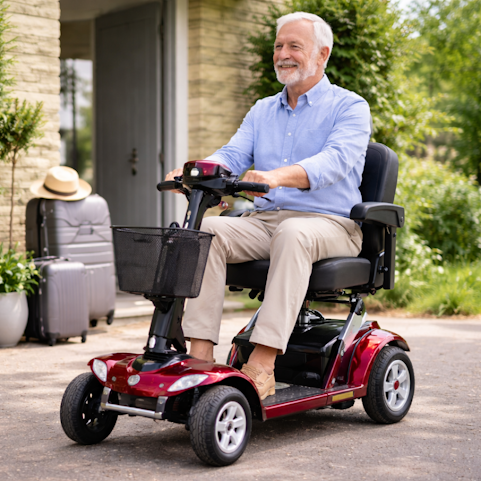
A folding mobility scooter is designed for people who want independence without the bulk of a traditional scooter. It offers a balance between portability and everyday usability, making it suitable for travel, shopping trips, and short journeys.
This guide explains what matters when choosing one and who they are best suited for.
A folding mobility scooter is a compact, lightweight scooter that can be collapsed for storage or transport. Unlike standard models, it does not need to be taken apart.
Some models fold manually, while others use an automatic mechanism that works at the press of a button.
The key advantage is convenience. Once folded, the scooter can usually fit into a car boot, cupboard, or even be taken on public transport.
Folding scooters are best suited to people who:
· Need help with mobility but still travel regularly
· Want something easy to store at home
· Use a car and need to lift or transport the scooter
· Go on holidays and require a portable solution
They are less suitable for users who need high weight capacity or long-distance travel, as folding models are designed to be lightweight rather than heavy-duty.
The lighter the scooter, the easier it is to lift and transport. Some ultra-lightweight models weigh around 14kg without the battery, making them manageable for many users.
If lifting is a concern, consider whether you will need assistance or a hoist.
There are two main types:
· Manual folding – Lighter and often quicker once familiar
· Automatic folding – Folds at the press of a button, useful if dexterity is limited
Manual models tend to be lighter, while automatic ones offer convenience.
Folding scooters usually have smaller batteries to keep weight down. This means a shorter travel range compared to larger scooters.
Think about how far you typically travel in a day and choose accordingly.
Because they are compact, folding scooters may have:
· Smaller wheels
· Tighter seating
· Less suspension
If comfort is important, test the scooter before buying where possible.
A key benefit is that most models can be stored without taking up much space. Many can be placed in a car boot without dismantling, saving time and effort.
· Easy to transport in a car or on public transport
· Quick to fold and store
· Lightweight compared to standard scooters
· Ideal for travel and short trips
These features make them a practical option for maintaining independence without committing to a larger mobility aid.
Folding scooters are not designed for every situation. You should be aware of:
· Reduced battery range
· Lower weight capacity
· Less comfort on uneven terrain
· Smaller wheels, which may struggle outdoors
If you regularly travel long distances or need more support, a standard mobility scooter may be more suitable.
Start with how you plan to use the scooter:
· For shopping and local trips: prioritise comfort and stability
· For travel: focus on weight and folding speed
· For car use: check boot size and lifting weight
If possible, try a model before buying. This helps you understand how it feels in real use and whether it meets your needs.
A folding mobility scooter offers a straightforward way to stay mobile without added complexity. It suits people who value convenience, portability, and ease of use.
Choosing the right mobility scooter comes down to balancing weight, range, and comfort. Once these are matched to your lifestyle, a folding scooter can make every day travel far more manageable.
04 Jun 2026
14 May 2026
08 May 2026